Grants
November 24, 2022
TGF Grant Funds Weatherproof Gear Closet for Outdoor School
2023 IMPACT REPORT STORY
Get dirty. Take risks. Brave the elements. Those are not usually the lessons of preschool. But for a small group of intrepid four-year-olds, those lessons fit perfectly with ABCs and 123s at the Community Nursery School’s new Nature School, funded with a grant from The Guilford Foundation.
The Community Nursery School (CNS) started in the 1950s as a cooperative nursery school where parents and families have an opportunity and responsibility to participate in their children’s day-to-day learning. Today more than 50 families are enrolled. The curriculum is play-based, meaning that all lessons derive from children’s natural inclination to explore, imagine and create at their own pace. Their social and emotional growth is the primary focus.
The concept of outdoor preschool education has also been around for decades. But in today’s society, it has taken a backseat to the idea that children need a jumpstart on reading, writing, and arithmetic to ensure their academic success in later years. CNS was committed to the concept of outdoor education. The first project was an open-air art studio when the Covid-19 pandemic, delaying the project until 2021.
The more significant project was an outdoor school, a concept championed by teacher Julie Souvlis so kids could continue learning, socializing, and recreating. The pandemic accelerated the timing: the Nature School officially opened in the spring of 2022 with eight students. Because it takes place entirely outside, children must be dressed for various weather conditions over their three-hour school day. The TGF grant was used to stock a gear closet of waterproof and windproof pants, coats, hats, mittens, and boots in toddler sizes.
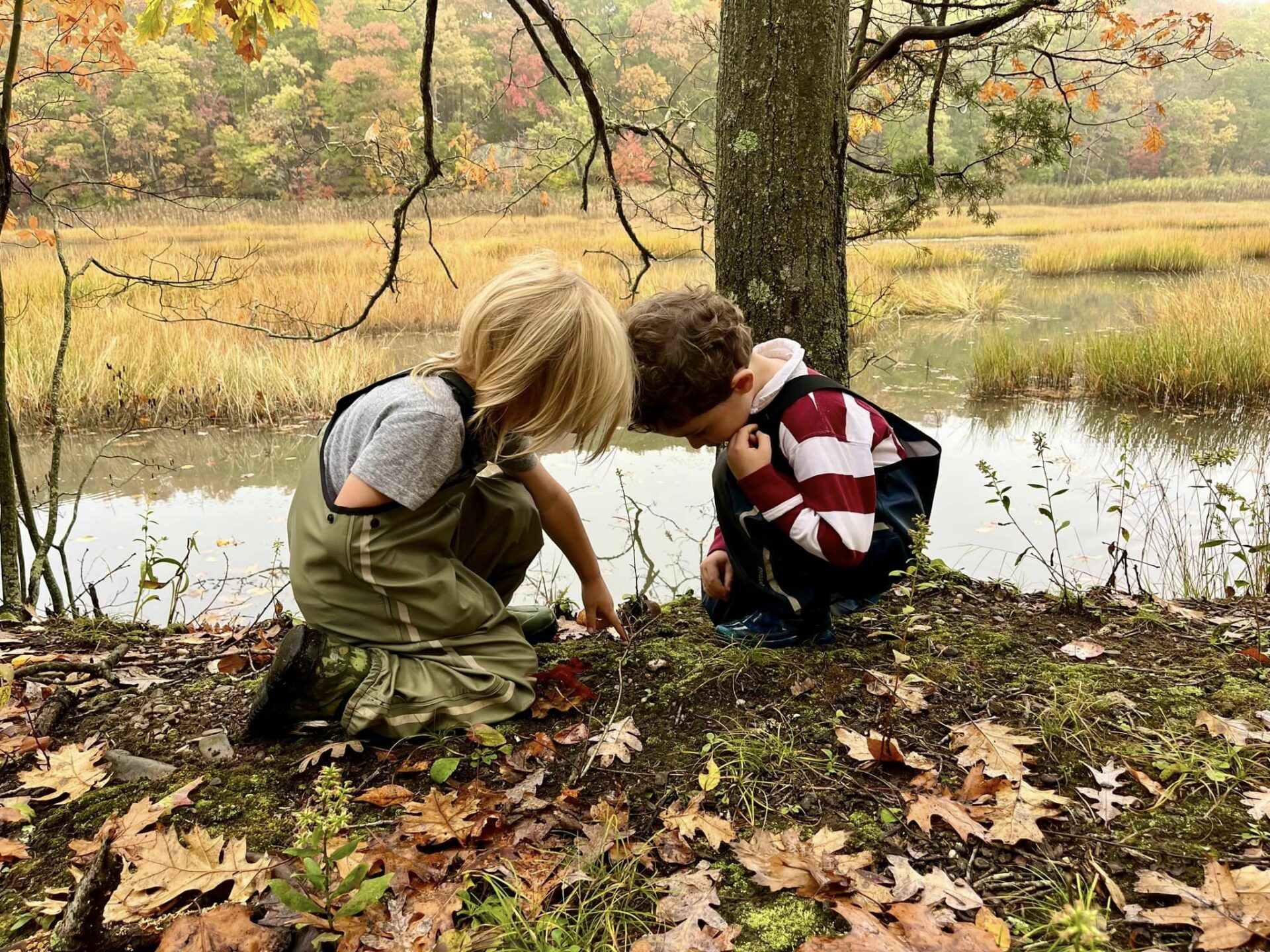
“Those things can be expensive, and we didn’t want that to be a barrier for anyone,” explains director Rachel Daniels. She hopes to expand the gear closet as families literally grow out of the program and the clothes. But it’s important that children be appropriately dressed for getting dirty, splashing in puddles, climbing over rocks and trees, and collecting treasures to study (and return to their natural home).
They also used part of the grant to purchase a small wooden bridge that represents the threshold of the rustic outdoor classroom, known as basecamp. Once the children cross the bridge, their school day is structured the same as indoors in terms of lessons, but using supplies and tools found outside.
“This wasn’t something we couldn’t have funded on our own. We needed some basic things to launch the program,” Daniels says. The first year has been so successful that there are now waiting lists for additional programs for two-, three- and five-year-olds. “As a non-profit trying to keep tuition low for our families, we couldn’t grow like that without the support of The Guilford Foundation.”
Just as it is inside, the students’ interests guide the learning activities. Before crossing the bridge, for example, the children walk along a path they planted with daffodils. When the children noticed the flowers might be in danger of being trampled, it became a project to collect rocks of similar size to create a visual barrier. Then it became a project to count the rocks and mark groups of 10.
Within the basecamp, there are designated spaces for circle time, imaginative play, and arts and crafts. Tree roots become the boundaries of a make-believe vignette. A small wooden crate becomes a kitchen stove. A peculiar rock outcropping becomes a horse one day or a boat the next, depending on the game. Teachers have noticed that the games and stories outside often continue over several days. “They are more imaginative and inventive with the materials at their disposal,” Souvlis notes.
Each day, the students walk on nearby trails, and together the class creates a map with landmarks the children have named, such as Moss Rock, Old Fort, Secret Path, Play Marsh, and Big Marsh. They are the same marsh, but the children recognize one area for play and the other for observing wildlife and creating a field guide of species such as egrets, herons, toads, and snakes.
Indeed, teachers have noticed children connect more with one another and gain more confidence as they help each other to scale a rock, forge a stream, or climb over a fallen log. And parents have reported their children taking a leadership role on family hikes.
SHARE THIS STORY




Stay up-to-date